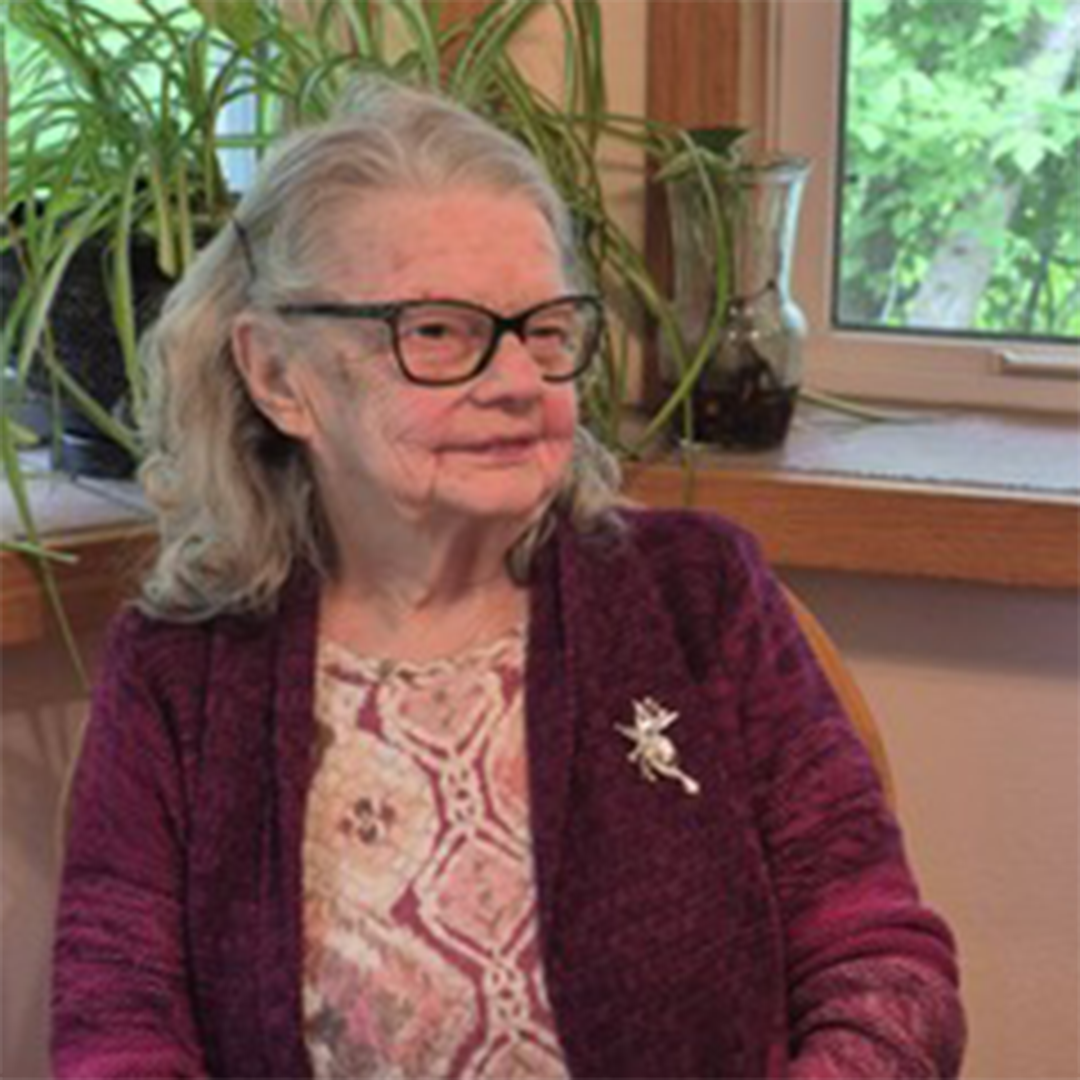
Mary Christensen
Mary Christensen’s life began on a small farm near Evansville and grew into decades of service to her family, church, and community. Her story reflects faith, resilience, and a lifelong commitment to helping others.
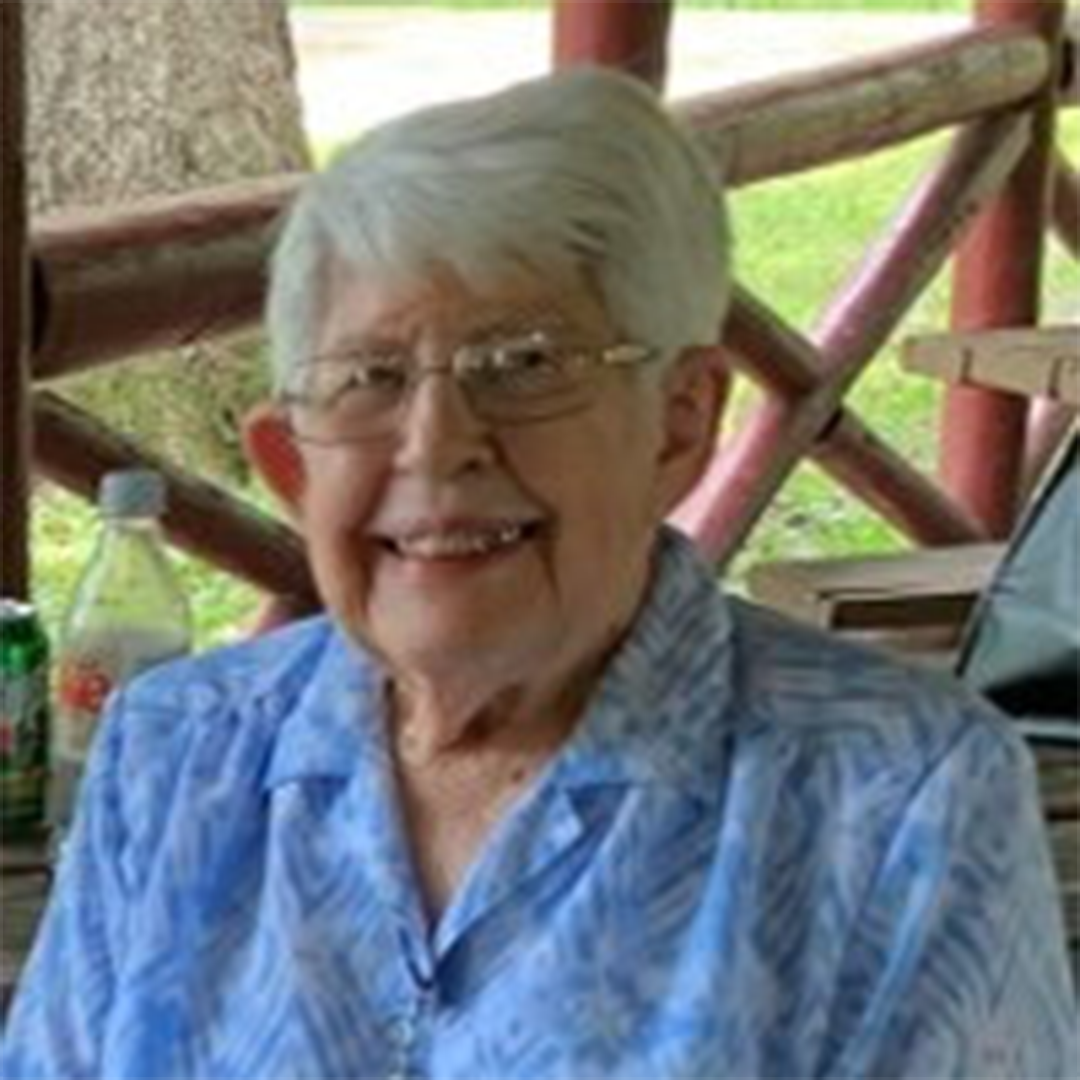
Mary
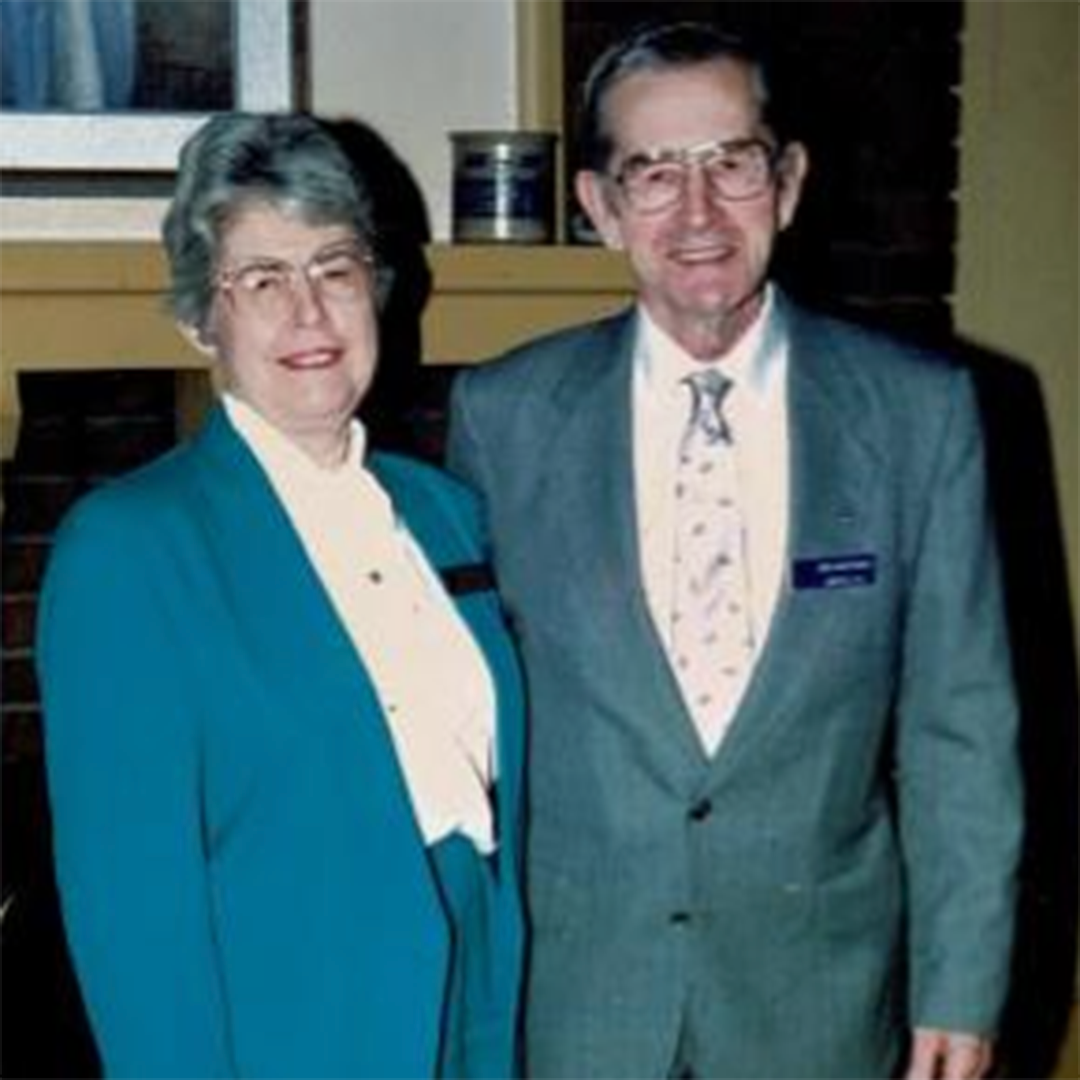
Mary and her husband, Herb
Mary Christensen was born on a farm near the south end of Evansville. Her parents were Victor and Maude Tullis. She was the youngest of five children (her siblings were two sets of female twins). Her father sometimes heard his friends jibe about having five girls instead of boys, who would be of more value on the farm. Her father’s response was, “You’re gonna have to buy cars for all your boys, and all I have to do is provide parking spaces.”
Mary began country school at the age of five, but she was already well prepared because she and her sisters played “school” in their home. They even had a blackboard that Victor made for them, complete with a tray for erasers and chalk. Mary’s parents put a very high priority on education. Mary was always one of her sisters’ “students”, since she was the youngest. It was here that she received an early introduction to phonics, math, and other subjects. Therefore, when Mary began attending Furseth Country School, she was well qualified to enter the first grade.
The Furseth School actually adjoined Victor and Maude’s farm, so Mary and her siblings walked only a quarter mile each way. Even in the winter it didn’t seem too far.
Victor purchased the farm with a mortgage in 1917, four years before he and Maude were married. The family had eight cows, five workhorses, and several sheep and chickens. The big barn had five stalls for the horses and eight stanchions for the cows. There were also pens in the back of the barn for calves.
They kept horses because they pulled farm machinery for fieldwork. This was before the age of tractors. Carl Spersrud was the hired man, and his brothers helped out as well during planting and harvest. Together with Mary’s parents, they raised corn, oats, and a new crop at the time, alfalfa. They also practiced crop rotation.
All went well until the Great Depression came along in the thirties. As a result, all Victor could pay was the interest. Then tragedy struck when Victor was killed in a car accident in 1938. The country was just coming out of the depression at the time of his death. The family continued to live on the farm until the summer of 1940. They tried to manage with the help of a hired man, but due to the economic circumstances, they could only pay the interest on their loan from the former owner. Farm values had decreased significantly, and the farm was actually worth less than what Harold had paid for it, so Maude lost the farm.
In the spring of 1939, they held an auction for the livestock and machinery. Fortunately for the family, Victor had a $2,000 life insurance policy, which gave Maude the means to buy a house in town.
Mary had to deal with the death of her father, moving to town, and attending what she calls “town school”. At that time, she was the only sister still attending country school. Her elder sisters had already moved to “town school”. Mary’s transition was a big challenge for her. Besides losing her father and moving to town, she still had to finish country school. Mary finished sixth grade there, even though she was one year younger than her classmates. But Mary had one last opportunity to shine. She entered the district “spelling bee” and competed against seventh and eighth-graders. The district consisted of several area country schools, and there were no restrictions on who could participate. Mary won the district spelling bee and went on to enter the “county bee”. There she made it to the second round, where she was defeated, but she felt good about her performance.
At the time of Victor’s death, he owned an automobile, a whippet. Maude had never learned to drive. By then, Doris and Lois (the eldest twins) were in high school. There were no school buses at that time, so Maude had to come up with a way for the four elder girls to get to and from school. A nearby neighbor had a big family with two boys in high school, but they didn’t have a car. So Maude made an arrangement with them. She gave Victor’s car to the family in return for the boys' transporting the girls to and from school. It worked out well for both families.
When Mary reported for her first day of “town school”, she encountered her first hurdle. The seventh-grade teacher, whose class Mary hoped to attend, told her she couldn’t possibly start in seventh grade because she looked too young. This was partly because Mary was short for her age. But Mary had come prepared, armed with her sixth-grade report card from the “country school”. Eventually, the school administration granted her request, even though, due to her short stature, she looked like a fourth- or fifth-grader.
Mary knew she was intelligent, but she wanted to grow in stature so that she would fit in better with her classmates. For example, when she entered eighth grade, all students were weighed, and their weight was noted on their report cards. During the ‘weighing’ process, one teacher would call out each student's weight to the teacher who recorded it. Mary still remembers that only two students weighed in at less than 100 pounds. She was one of them. Fortunately, she began to grow in stature during her sophomore year.
By this time, Mary’s two eldest sisters, Doris and Lois, had graduated from high school and entered the work force in Madison. Doris and Lois rode to Madison in the cab of a pickup truck with a man who drove them and additional male commuters who rode in the back. The men in the back used a tarp to try to keep warm in the winter. This was during World War II, and women had little trouble finding work because most men were fighting. Lois worked at a lawyer’s office on the square, and Doris took a bus from the square to work at the Madison plow company.
Once all four of the elder sisters had jobs in Madison, they rented an apartment there. Edith and Evelyn went to work after their high school graduation as well. Doris and Lois started out riding in the cab of a pickup truck from Evansville to the square in Madison. They rode in the cab with the driver, and the remaining men sat in the back, protected from the weather by a tarp. The men worked at Gisholt, but they would drop the girls off at the square. Lois worked at a lawyer’s office on the square, and Doris took a bus to her employer, Madison Plow Company. When Edith and Evelyn joined the workforce, the four of them found an apartment in Madison.
Maude had been a country schoolteacher, and Mary says her mother was very frugal; she could stretch a dollar longer than anyone she knew. After they moved to town, she baked and sold food to generate some income. She could have applied for a widow’s pension, but she was too proud. In 1941, she applied for a part-time job at the grange store. She started out working in the dry goods/crockery department (vases and dishes). Sometime later, the manager of the men’s clothing department approached Maude with an offer to work in the men’s clothing department. Robert Richardson told Maude that he wasn’t sure if it would work, but if she was willing, the job was hers. She accepted the challenge. Imagine a man buying underwear from a woman in the 1940s! Although it is true that many women did the shopping for their husbands’ clothes. But Maude was successful, and she worked there until her retirement in 1961. And of course, she was paid less than the men. In addition, her home was on the north end of the old viaduct (which many locals will remember). This meant she had to walk over it in the dead of winter.
Meanwhile, Mary’s sisters, Doris & Lois, bought Mary a winter coat and a new dress for the freshman reception. She also joined the band and played the baritone, which looks like a small tuba. Mary would have preferred a French horn, but the school owned the instruments, and there was only one, which was already spoken for. So, she was offered a baritone, which had a similar sound and range. In high school, Mary was first chair in the baritone section of the school band, and Richard Rasmussen was the second chair. On the other hand, Mary hated gym class because she was not athletic. The gym classes often consisted of teams competing in games. The girls were chosen by the team captains. Games that involved students being “picked” to join a team. Mary was always the last to be chosen.
Mary also babysat for 10 cents an hour (no matter how many children the family had!), which was all turned over to her mother. One family in particular had 4 or 5 children for Mary to care for. On Saturday nights, the mother would have the meal ready, but Mary made sure the kids ate the food, then she washed the dishes and bathed each child.
An example of Maude’s temperament occurred when she, Edith, and Mary were in the backyard working in the garden. They heard a huge crash coming from the house. When they rushed to the kitchen to see what had happened, they saw that the huge, heavy cupboard that had been nailed to the wall had fallen to the floor. Maude’s comment was, “Well, I’ve always thought that I would prefer the cupboard to be on this other wall instead”. Somehow, she, Mary, and Edith rehung the cupboard, with Maude pounding the big nails into the wall with a hammer.
Throughout her growing-up years, Mary cannot remember a time when she did not love Jesus. The family always said grace at every meal, and they all went to Sunday school and church. Of course, they had to finish the farm chores before 10:00am Sunday school. The whole family tried to follow Christ’s teachings.
In high school, Mary continued to sing in the chorus, which was an elective. As a freshman, it was the first year they were allowed to take algebra. Mary took it and loved it; in fact, she loved geometry and trigonometry as well. She really enjoyed math. She remembers her teacher, Mrs. Maas, calling on a couple of students to solve a problem, but they couldn’t. Mrs. Maas then asked Mary, and she solved it. She thought she might be a math teacher, although she was also interested in missionary work, which she learned about in Sunday school. Though it was almost twenty years later, Evansville High School prepared her well for her future job at Union Bank & Trust Company. Her love of math and learning to type gave her the skills she needed.
Mary graduated as valedictorian of her class in 1946. She carried band as a fifth subject. In one of her classes, advanced typing, she was assigned to a teacher to type their test papers. She was assigned to Mrs. Maas, the math teacher.
Mary’s future husband Herb, came into her life when she was 12 or 13. He was from Stanley, WI, and he happened to come to Evansville because he was helping a family move from Stanley to Evansville. Once here, he decided to seek out work as a hired man. When he started attending the same church as Mary’s family, Maude noticed he always came alone. Maude admired Herb for that. She often invited him to their home for Sunday dinner. So Herb sat at the dining room table with five young girls and their mother. As time went on, Herb never dated the four elder girls. But when Mary turned sixteen, he asked her for a date. Mary, of course, said yes as she was already head over heels with him. She wanted to become a housewife, which prevented her from attending college. Herb had worked on the Woodworth farm for three years and had arranged to rent it. He gave Mary a diamond, and they were married on February 16, 1947, when Mary was 17. Maude told a friend that Herb was a very nice young man, old enough to get serious, but Mary was still young. They honeymooned in northern Minnesota and southern Canada in the dead of winter. Needless to say, it was a cold honeymoon. During the honeymoon, although Mary did not yet have a driver’s license, she learned to shift the gears after Herb stepped on the clutch.
Herb and Mary rented the Wade Woodworth farm for seven years. It consisted of 160 acres, or a quarter-section. By then, they had tractors, although horses were still used for some crops, such as oats. Harvesting oats was an especially busy time on the farm. Each farmer would cut his own crops and tie them into bundles using a machine called a binder. Then the binders would be stacked into shocks, which looked like small haystacks. The shocks were then put on a hayrack.
Threshing grain was a much more cooperative effort, with neighbors working together on each other’s farms. A threshing machine owner would choose a neighborhood and go from farm to farm, signing up 8-10 farmers to form what was called a “run”. Each farm would send one or more workers to each farm (some would also send a horse and a wagon with a team of horses). The group would go from farm to farm until all the grain was harvested. The threshing machine would separate the grain from the straw, and the harvest was very labor intensive. The housewife on each farm would provide a hearty meal for the crew on the day or days they were at her farm. Depending upon the size of the “run”, this could mean 12-18 hungry men. So, in the summer of 1947, Mary faced her first big challenge as a farmer’s wife. Her mother, Maude, had trained her well, and she passed with flying colors. They also hired 10-20 thrashers for fieldwork. Herb didn’t want Mary to learn how to milk the cows. He had observed that women who did the milking were soon expected to help with all the barn work. Mary kept out of the barn for the most part, but she still had some responsibilities there, including feeding the calves, washing the milking machines, taking care of the chickens, and helping with some fieldwork. But her main job was being a homemaker.
Their son Alan was born in 1948, and their daughter Shirlee was born in 1952. Mary and Herb quit farming in 1954. Herb had two floating ribs, and physical farm work became painful for him. Herb then went to the coop after taking a management training course offered by the Midland Cooperative, a large regional coop that supplied the local coops. He was not quite finished with the training when he was hired to work at the coop in Wilton, WI.
Herb was up there alone for a couple of months, then the family followed him. Herb found an apartment. It was a couple of miles outside of town. Alan started third grade at Dorset Valley Country School, and Shirley started country school in 1959. Herb looked for another job and was hired to manage the coop in Columbus. So, this was a good move for the kids because of the better quality of Columbus’ school, but as far as Herb’s employment was concerned, it was a step down. They resettled in Columbus, WI, because Wilton schools were below par. The coop in Wilton was doing well, but the one in Columbus was not. He replaced an old man who wanted to retire. After Herb was hired, the older man wanted to come back. They were there for four years, then moved back to Evansville, where Herb was hired as the credit manager, though he also helped spread fertilizer and chemicals.
Herb encouraged Mary to look for a job locally since it may take a while to find one. After both children entered school, Mary applied for a job at Union Bank & Trust Company in 1965. She retired from her job at the canning company and prepared for the move into their new home. She and Herb bought a house from an estate, which also included a lot of personal property. Leonard Eager Sr. gave them the mortgage loan for their house on N Third St. In 1965. Alan Eager was the personnel manager at the time. When Mary asked if they were hiring, he said they didn’t have any openings at the moment, but he kept her application on file. Amazingly, Alan called her the next day and said a woman had turned in her resignation! He asked if Mary could come in on Saturday for an interview. He hired her on the spot, and she began working there on Monday.
Thus began her 26-year career in the loan department at UB&T. She filled in at the teller line when it was busy. She sent out notices for overdue payments. She also typed up single-payment and installment loan documents.
Leonard Eager, the bank president, was hard on new help, but once you passed muster, he was very good to you. One time he called her into his office to ask her to prepare a note for a husband and wife. She didn’t have any paper or a pen to write with, so when Leonard told Mary the names of the couple, the due date of the single-payment loan, and the interest rate, she went out to prepare it, but she couldn’t remember all the information. So, she had to go back into his office to ask him to repeat the details. His reply was, “You heard me the first time.” Many years later, when Leonard’s eyesight deteriorated, he asked Shirley Gransee to look up someone’s phone number. She looked it up and read it out to him. A few minutes later, he asked, “What was that number again, Shirley”? She replied, “You heard me the first time”. Another time, Mary filled out a dairy assignment form, but it had a visible erasure. Leonard ripped it up when he saw it, adding, “This bank has higher standards than that one.” As time went by, Leonard was very good to Mary. She was promoted to assistant cashier which involved greater responsibilities.
Once a year, the bank employees’ pay was reviewed. In one particular year, Alan met with her to discuss her salary. He asked her what she thought she should be paid, and she replied, “I would like to be paid the same rate that you would pay a man”. That was in 1986.
During their daughter Shirley’s senior year (1969-70), the family took in a foreign exchange student named Pam Long. The family had to apply to receive a student through the American Field Service. They thought it would be a great experience to have a foreign student in their home. Alan had graduated, and Shirley was the only family member in high school. The family had no idea where the student would be from. Pam already spoke English. She grew up on a family dairy farm in South Africa. They raised cattle and sheep. Pam was also a Christian. Mary and Herb, as did Shirlee, thoroughly enjoyed having a foreign exchange student.
In 1977, Herb and Mary arranged a trip to visit Pam in South Africa. They spent three days in Rome and then flew on to Johannesburg. They were met by Pam's uncle and aunt. They took a VW bus tour from Johannesburg to Durban, through the Kruger National Park.
Mary visited South Africa again after Herb died, and later on, she visited Alaska as well. She was still drawn to missionary service.
Mary retired in 1991. In 1997, Herb had open heart surgery, but he passed away from pulmonary fibrosis during the year of their golden wedding anniversary. In 2000, at the age of 52, their son Alan died from cardiomyopathy, a heart disease.
In October of 1998, Mary had the opportunity to serve as a volunteer missionary in Cordova, Alaska. She worked at the Christian center there. It was part of the mainland of Alaska, and it was quite isolated because of the mountains, so to get there, you had to either fly in or come by ferry. It was a wonderful experience. Salmon was the lifeline of Cordova. They had 4-5 canneries. The population was 2,500, except during the fishing season, when it doubled to 5,000. Mary was drawn there by all the children’s programs. She was interested in working with children. The majority were Caucasian. The Christian center also ran a little restaurant. All of the other restaurants were in bars, so this one had a niche because it was for young people and those who didn’t frequent bars. Mary served primarily as a cook. She enjoyed working with the kids, and a few fishermen would come in to eat. She spent one full year there.
Although from early childhood on, Mary had a deep desire to serve as a missionary, she never felt that her marriage to Herb was outside God’s will. In fact, in retrospect, she feels her “true calling” was to work with children. Wherever they lived during her life, Mary taught Sunday school and vacation bible school. At one time or another, she taught all ages from pre-school through eighth grade. Working with children brought her great joy.
Mary never felt that she was living outside God’s will,, and she is thankful for all the marvelous opportunities she has had in her life.
In conclusion, Mary can say with the psalmist, “Surely goodness and mercy shall follow me all the days of my life, and I will live in the house of the lord forever” (Psalms 23:6). Thank you, Lord.